
10
мар
| Platforms: | PC |
| Publisher: | Eidos Interactive |
| Developer: | Looking Glass Studios |
| Genres: | 3D Shooter / Stealth |
| Release Date: | December 3, 1998 |
| Game Modes: | Singleplayer |
Dec 20, 2017 The series consists of Thief: The Dark Project (1998), Thief II: The Metal Age Thief – PC - Yify Torrents Thief is a series of stealth video games in which the player takes the role of Garrett, a master thief in a fantasy/steampunk world resembling a cross between the Late Middle Ages and the Victorian era, with more advanced.
Sneak into castles and knock guards comatose.
Sneaking around a wealthy manor.
Stealth really took off as a popular gaming concept with Thief: The Dark Project, a ‘first-person sneaker’ set in a dark fantasy world. You wear the hood of master kleptomaniac Garrett, a guy with a cynical personality and a knack for pilfering valuable goods. Much of the game takes place in and around a dense urban environment known only as the City, but your night-bound journeys eventually take you to even less savory areas – tombs, catacombs or haunted mines. The game world is an entertaining mix of medieval, fantasy and steampunk themes, with electrical lighting coexisting alongside steam machinery and broadswords.
The levels are varied, with locations ranging from manors, prisons, cathedrals, tombs, city streets and much more. Each and every level is brimming with detail and scope, and they range from straightforward robbery to more obscure assignments, like shadowing a group of thugs through the dark city streets without getting noticed. Levels are scripted and dynamic, with objectives sometimes changing on the fly.
As before, Thief is stealth-oriented, and as such encourages (but never forces) its players to use cunning in favor of direct confrontation. Avoiding detection by hiding in the dark and making as little noise as possible around enemies is often the best way to go. The AI is revolutionary, allowing guards to react to both how visible and audible you are around them. Their alertness range from mild suspicion to alarm and finally full blown combat should they find you. Fortunately, they’re keen on commenting their surroundings, making it easy to gauge their level of alertness.
- Visiting the Lost City.
- En-garde!
- A quiet rose garden.
* * *
With some noticeable shortcomings, the AI performs admirably. The pathfinding is magnificent in most instances – a guard can spot you one floor down, manage to run through the hallways and up the main stairs, and find the exact room where he’d spotted you minutes earlier. And once they have you zeroed in, they’re incredibly hard to shake off on foot. The alarm sounds off, other guards join in, and eventually you’re cornered and chop-sueyed. But alas, the AI does have limits as to where it can follow you – jump into a river, climb a ladder or rope, or really climb past any obstacle that can’t be navigated around on foot will hopelessly block the AI pathfinding – which isn’t always a problem since they may be packing longbows. If you do choose to stand your ground then guards make decent sparring partners – you can swing your sword or block their swings, though with a bit of practice it becomes quite easy to chop enemies down to size.
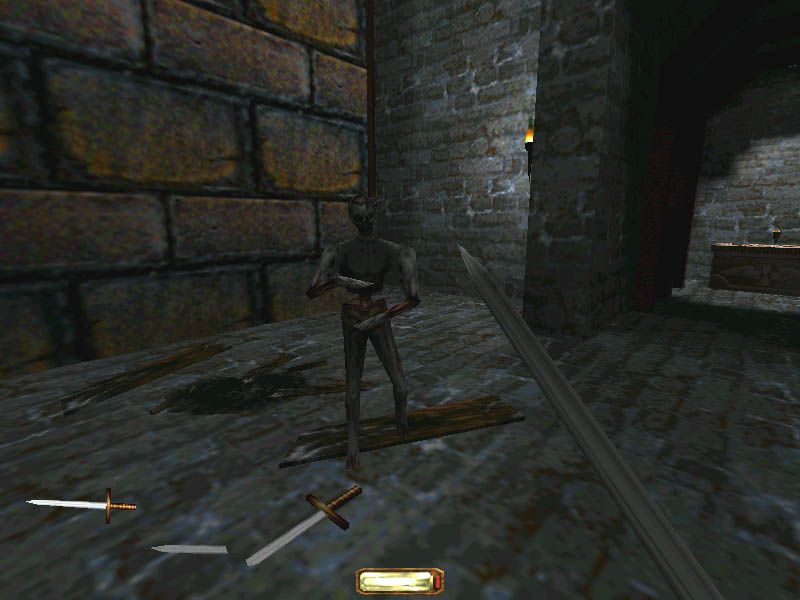
TDP places you into several difficult spots, like this haunted cathedral crawling with undead.
The game hands over an assortment of specialized gear. There’s a broadsword for those bloody close encounters, a blackjack to silently club unwary opponents unconscious, and a very useful bow that can be combined with 7 different arrows. Out of the three weapons, the bow is by far the most versatile. A few interesting selections include water arrows that douse torches, moss arrows to cover loud surfaces, noisemaker arrows that distract enemies or rope arrows that allow access to new areas. Inventory items complete this armory, with a range of potions (healing, speed, etc), mines, grenades or holy water to sprinkle on restless zombies.
Garret himself is pretty agile; he can climb ledges, swim underwater, carry bodies or lean around corners to get a better view of things without exposing himself, and indeed a greater part of the game can be played without relying too much on equipment. Yet the stuff you will use cost money, which is why meticulous thieving is so important in this game. Unspent loot isn’t kept for subsequent missions, encouraging players to find every treasure so they can can afford the best gear for the follow-up mission. Every bit of this game is awesome, and I highly recommend playing it. Be sure to install this Thief Fix if you have trouble running this game on a modern OS or anything that doesn’t use a single-core processor.
System Requirements: 100 Mhz CPU, 16 MB RAM, 50 MB HDD, Win 95/98
- Buy Game
www.gog.com
www.steam.com
www.amazon.com - Download Demo
archive.org - Vintage Website
www.lglass.com
Tags: Free Download Thief The Dark Project Full PC Game Review
upd
1 vote
To bookmarks- Free Download
- Torrent
Download Thief II Free for PC Torrent
Thief II: The Metal Age is a 2000 stealth video game developed by Looking Glass Studios and published by Eidos Interactive. Like its predecessor Thief: The Dark Project, the game follows Garrett, a master thief who works in and around a steampunk metropolis called the City. The player assumes the role of Garrett as he unravels a conspiracy related to a new religious sect. Garrett takes on missions such as burglaries and frameups, while trying to avoid detection by guards and automated security.
Thief II was designed to build on the foundation of its predecessor. Naruto shippuden filler summary. In response to feedback from players of Thief, the team placed a heavy focus on urban stealth in the sequel, and they minimized the use of monsters and maze-like levels. The game was made with the third iteration of the Dark Engine, which had been used previously to develop Thief and System Shock 2. Thief II was announced at the 1999 Electronic Entertainment Expo, as part of an extended contract between Looking Glass and Eidos to release games in the Thief series. Looking Glass neared bankruptcy as the game was developed, and the company was kept running by advances from Eidos.
Thief II received positive reviews from critics, and its initial sales were stronger than those of its predecessor. However, the game's royalties were processed slowly, which compounded Looking Glass's financial troubles. As a result, the company closed in May 2000, with plans for Thief III cancelled. The third game in the series, entitled Thief: Deadly Shadows, was developed by Ion Storm and published by Eidos in 2004. Thief 2X: Shadows of the Metal Age, a widely praised expansion mod for Thief II, was released in 2005. In 2014, Square Enix published a reboot of the series, developed by Eidos Montréal.
Gameplay
Video Review and Screenshots
- Operating System: Microsoft Windows XP
- Processor: 1.8 GHz
- RAM: 512 MB
- Video Card: DirectX 7
- Hard disk space: 2 GB
(Downloaded [2])
Thief 2014
hit
new

The Swindle
hit
new
Stolen
hit
new
Sneaky Sneaky
hit
new
The Raven: Legacy of a Master Thief
hit
new
Randal's Monday
hit
new
Freddi Fish 3: The Case of the Stolen Conch Shell
hit
new
Arcatera
hit
new
Leave a Reply
Popular Posts
Platforms: PC Publisher: Eidos Interactive Developer: Looking Glass Studios Genres: 3D Shooter / Stealth Release Date: December 3, 1998 Game Modes: Singleplayer Dec 20, 2017 The series consists of Thief: The Dark Project (1998), Thief II: The Metal Age Thief – PC - Yify Torrents Thief is a series of stealth video games in which the player takes the role of Garrett, a master thief in a fantasy/steampunk world resembling a cross between the Late Middle Ages and the Victorian era, with more advanced.
Sneak into castles and knock guards comatose.
Sneaking around a wealthy manor.
Stealth really took off as a popular gaming concept with Thief: The Dark Project, a ‘first-person sneaker’ set in a dark fantasy world. You wear the hood of master kleptomaniac Garrett, a guy with a cynical personality and a knack for pilfering valuable goods. Much of the game takes place in and around a dense urban environment known only as the City, but your night-bound journeys eventually take you to even less savory areas – tombs, catacombs or haunted mines. The game world is an entertaining mix of medieval, fantasy and steampunk themes, with electrical lighting coexisting alongside steam machinery and broadswords.
The levels are varied, with locations ranging from manors, prisons, cathedrals, tombs, city streets and much more. Each and every level is brimming with detail and scope, and they range from straightforward robbery to more obscure assignments, like shadowing a group of thugs through the dark city streets without getting noticed. Levels are scripted and dynamic, with objectives sometimes changing on the fly.
As before, Thief is stealth-oriented, and as such encourages (but never forces) its players to use cunning in favor of direct confrontation. Avoiding detection by hiding in the dark and making as little noise as possible around enemies is often the best way to go. The AI is revolutionary, allowing guards to react to both how visible and audible you are around them. Their alertness range from mild suspicion to alarm and finally full blown combat should they find you. Fortunately, they’re keen on commenting their surroundings, making it easy to gauge their level of alertness.
- Visiting the Lost City.
- En-garde!
- A quiet rose garden.
* * *
With some noticeable shortcomings, the AI performs admirably. The pathfinding is magnificent in most instances – a guard can spot you one floor down, manage to run through the hallways and up the main stairs, and find the exact room where he’d spotted you minutes earlier. And once they have you zeroed in, they’re incredibly hard to shake off on foot. The alarm sounds off, other guards join in, and eventually you’re cornered and chop-sueyed. But alas, the AI does have limits as to where it can follow you – jump into a river, climb a ladder or rope, or really climb past any obstacle that can’t be navigated around on foot will hopelessly block the AI pathfinding – which isn’t always a problem since they may be packing longbows. If you do choose to stand your ground then guards make decent sparring partners – you can swing your sword or block their swings, though with a bit of practice it becomes quite easy to chop enemies down to size.
TDP places you into several difficult spots, like this haunted cathedral crawling with undead.
The game hands over an assortment of specialized gear. There’s a broadsword for those bloody close encounters, a blackjack to silently club unwary opponents unconscious, and a very useful bow that can be combined with 7 different arrows. Out of the three weapons, the bow is by far the most versatile. A few interesting selections include water arrows that douse torches, moss arrows to cover loud surfaces, noisemaker arrows that distract enemies or rope arrows that allow access to new areas. Inventory items complete this armory, with a range of potions (healing, speed, etc), mines, grenades or holy water to sprinkle on restless zombies.
Garret himself is pretty agile; he can climb ledges, swim underwater, carry bodies or lean around corners to get a better view of things without exposing himself, and indeed a greater part of the game can be played without relying too much on equipment. Yet the stuff you will use cost money, which is why meticulous thieving is so important in this game. Unspent loot isn’t kept for subsequent missions, encouraging players to find every treasure so they can can afford the best gear for the follow-up mission. Every bit of this game is awesome, and I highly recommend playing it. Be sure to install this Thief Fix if you have trouble running this game on a modern OS or anything that doesn’t use a single-core processor.
System Requirements: 100 Mhz CPU, 16 MB RAM, 50 MB HDD, Win 95/98
- Buy Game
www.gog.com
www.steam.com
www.amazon.com - Download Demo
archive.org - Vintage Website
www.lglass.com
Tags: Free Download Thief The Dark Project Full PC Game Review
upd- Developer: Looking Glass Studios
- Release date: 2000
- Platform: Windows (PC)
- Genre: Stealth-Action
- Version: Full Game
1 voteTo bookmarks- Free Download
- Torrent
Download Thief II Free for PC Torrent
Thief II: The Metal Age is a 2000 stealth video game developed by Looking Glass Studios and published by Eidos Interactive. Like its predecessor Thief: The Dark Project, the game follows Garrett, a master thief who works in and around a steampunk metropolis called the City. The player assumes the role of Garrett as he unravels a conspiracy related to a new religious sect. Garrett takes on missions such as burglaries and frameups, while trying to avoid detection by guards and automated security.
Thief II was designed to build on the foundation of its predecessor. Naruto shippuden filler summary. In response to feedback from players of Thief, the team placed a heavy focus on urban stealth in the sequel, and they minimized the use of monsters and maze-like levels. The game was made with the third iteration of the Dark Engine, which had been used previously to develop Thief and System Shock 2. Thief II was announced at the 1999 Electronic Entertainment Expo, as part of an extended contract between Looking Glass and Eidos to release games in the Thief series. Looking Glass neared bankruptcy as the game was developed, and the company was kept running by advances from Eidos.
Thief II received positive reviews from critics, and its initial sales were stronger than those of its predecessor. However, the game\'s royalties were processed slowly, which compounded Looking Glass\'s financial troubles. As a result, the company closed in May 2000, with plans for Thief III cancelled. The third game in the series, entitled Thief: Deadly Shadows, was developed by Ion Storm and published by Eidos in 2004. Thief 2X: Shadows of the Metal Age, a widely praised expansion mod for Thief II, was released in 2005. In 2014, Square Enix published a reboot of the series, developed by Eidos Montréal.
Gameplay
Video Review and Screenshots
- Operating System: Microsoft Windows XP
- Processor: 1.8 GHz
- RAM: 512 MB
- Video Card: DirectX 7
- Hard disk space: 2 GB
(Downloaded [2])Thief 2014hitnew The SwindlehitnewStolenhitnewSneaky Sneakyhitnew
 The Raven: Legacy of a Master ThiefhitnewRandal\'s MondayhitnewFreddi Fish 3: The Case of the Stolen Conch ShellhitnewArcaterahitnewLeave a Reply...'>Thief The Dark Project Pc Ita Torrent(10.03.2020)
Platforms: PC Publisher: Eidos Interactive Developer: Looking Glass Studios Genres: 3D Shooter / Stealth Release Date: December 3, 1998 Game Modes: Singleplayer Dec 20, 2017 The series consists of Thief: The Dark Project (1998), Thief II: The Metal Age Thief – PC - Yify Torrents Thief is a series of stealth video games in which the player takes the role of Garrett, a master thief in a fantasy/steampunk world resembling a cross between the Late Middle Ages and the Victorian era, with more advanced.
Sneak into castles and knock guards comatose.
Sneaking around a wealthy manor.
Stealth really took off as a popular gaming concept with Thief: The Dark Project, a ‘first-person sneaker’ set in a dark fantasy world. You wear the hood of master kleptomaniac Garrett, a guy with a cynical personality and a knack for pilfering valuable goods. Much of the game takes place in and around a dense urban environment known only as the City, but your night-bound journeys eventually take you to even less savory areas – tombs, catacombs or haunted mines. The game world is an entertaining mix of medieval, fantasy and steampunk themes, with electrical lighting coexisting alongside steam machinery and broadswords.
The levels are varied, with locations ranging from manors, prisons, cathedrals, tombs, city streets and much more. Each and every level is brimming with detail and scope, and they range from straightforward robbery to more obscure assignments, like shadowing a group of thugs through the dark city streets without getting noticed. Levels are scripted and dynamic, with objectives sometimes changing on the fly.
As before, Thief is stealth-oriented, and as such encourages (but never forces) its players to use cunning in favor of direct confrontation. Avoiding detection by hiding in the dark and making as little noise as possible around enemies is often the best way to go. The AI is revolutionary, allowing guards to react to both how visible and audible you are around them. Their alertness range from mild suspicion to alarm and finally full blown combat should they find you. Fortunately, they’re keen on commenting their surroundings, making it easy to gauge their level of alertness.
- Visiting the Lost City.
- En-garde!
- A quiet rose garden.
* * *
With some noticeable shortcomings, the AI performs admirably. The pathfinding is magnificent in most instances – a guard can spot you one floor down, manage to run through the hallways and up the main stairs, and find the exact room where he’d spotted you minutes earlier. And once they have you zeroed in, they’re incredibly hard to shake off on foot. The alarm sounds off, other guards join in, and eventually you’re cornered and chop-sueyed. But alas, the AI does have limits as to where it can follow you – jump into a river, climb a ladder or rope, or really climb past any obstacle that can’t be navigated around on foot will hopelessly block the AI pathfinding – which isn’t always a problem since they may be packing longbows. If you do choose to stand your ground then guards make decent sparring partners – you can swing your sword or block their swings, though with a bit of practice it becomes quite easy to chop enemies down to size.
TDP places you into several difficult spots, like this haunted cathedral crawling with undead.
The game hands over an assortment of specialized gear. There’s a broadsword for those bloody close encounters, a blackjack to silently club unwary opponents unconscious, and a very useful bow that can be combined with 7 different arrows. Out of the three weapons, the bow is by far the most versatile. A few interesting selections include water arrows that douse torches, moss arrows to cover loud surfaces, noisemaker arrows that distract enemies or rope arrows that allow access to new areas. Inventory items complete this armory, with a range of potions (healing, speed, etc), mines, grenades or holy water to sprinkle on restless zombies.
Garret himself is pretty agile; he can climb ledges, swim underwater, carry bodies or lean around corners to get a better view of things without exposing himself, and indeed a greater part of the game can be played without relying too much on equipment. Yet the stuff you will use cost money, which is why meticulous thieving is so important in this game. Unspent loot isn’t kept for subsequent missions, encouraging players to find every treasure so they can can afford the best gear for the follow-up mission. Every bit of this game is awesome, and I highly recommend playing it. Be sure to install this Thief Fix if you have trouble running this game on a modern OS or anything that doesn’t use a single-core processor.
System Requirements: 100 Mhz CPU, 16 MB RAM, 50 MB HDD, Win 95/98
- Buy Game
www.gog.com
www.steam.com
www.amazon.com - Download Demo
archive.org - Vintage Website
www.lglass.com
Tags: Free Download Thief The Dark Project Full PC Game Review
upd- Developer: Looking Glass Studios
- Release date: 2000
- Platform: Windows (PC)
- Genre: Stealth-Action
- Version: Full Game
1 voteTo bookmarks- Free Download
- Torrent
Download Thief II Free for PC Torrent
Thief II: The Metal Age is a 2000 stealth video game developed by Looking Glass Studios and published by Eidos Interactive. Like its predecessor Thief: The Dark Project, the game follows Garrett, a master thief who works in and around a steampunk metropolis called the City. The player assumes the role of Garrett as he unravels a conspiracy related to a new religious sect. Garrett takes on missions such as burglaries and frameups, while trying to avoid detection by guards and automated security.
Thief II was designed to build on the foundation of its predecessor. Naruto shippuden filler summary. In response to feedback from players of Thief, the team placed a heavy focus on urban stealth in the sequel, and they minimized the use of monsters and maze-like levels. The game was made with the third iteration of the Dark Engine, which had been used previously to develop Thief and System Shock 2. Thief II was announced at the 1999 Electronic Entertainment Expo, as part of an extended contract between Looking Glass and Eidos to release games in the Thief series. Looking Glass neared bankruptcy as the game was developed, and the company was kept running by advances from Eidos.
Thief II received positive reviews from critics, and its initial sales were stronger than those of its predecessor. However, the game\'s royalties were processed slowly, which compounded Looking Glass\'s financial troubles. As a result, the company closed in May 2000, with plans for Thief III cancelled. The third game in the series, entitled Thief: Deadly Shadows, was developed by Ion Storm and published by Eidos in 2004. Thief 2X: Shadows of the Metal Age, a widely praised expansion mod for Thief II, was released in 2005. In 2014, Square Enix published a reboot of the series, developed by Eidos Montréal.
Gameplay
Video Review and Screenshots
- Operating System: Microsoft Windows XP
- Processor: 1.8 GHz
- RAM: 512 MB
- Video Card: DirectX 7
- Hard disk space: 2 GB
(Downloaded [2])Thief 2014hitnewThe SwindlehitnewStolenhitnewSneaky SneakyhitnewThe Raven: Legacy of a Master ThiefhitnewRandal\'s MondayhitnewFreddi Fish 3: The Case of the Stolen Conch ShellhitnewArcaterahitnewLeave a Reply...'>Thief The Dark Project Pc Ita Torrent(10.03.2020)